Patan Durbar Square: A World Heritage Site Right in Your Backyard
Published by LMC Tourism | Lalitpur Metropolitan City
Have you ever stood in front of something so ancient, so beautifully crafted, that time seemed to pause? That moment is waiting for you — not in Europe, not in Asia’s far corners — but right here, just across the Bagmati River, in the heart of Lalitpur (Patan).
Many Nepali travelers rush to Pokhara or Chitwan for their holidays. Yet one of the world’s most remarkable living heritage sites sits quietly in our own Kathmandu Valley, often overlooked by the very people who live closest to it. Patan Durbar Square — listed as a UNESCO World Heritage Site — is not just a destination for foreign tourists. It belongs to us. It is us.
The Square That Has Stood for Centuries
Step through the entrance of Patan Durbar Square and you step into over a thousand years of Newari civilization. The square was the political and religious heart of the ancient Patan kingdom, ruled by the Malla kings whose ambition and artistry left behind a legacy that still leaves visitors breathless today.
At the center of it all stands the Krishna Mandir — a stunning temple built entirely in the Shikhara style, with 21 pinnacles rising towards the sky. Built by King Siddhi Narsingh Malla in 1637, it is said the king saw a dream vision of Lord Krishna and Radha, and immediately ordered a temple to be built in their honor. Along its stone friezes, scenes from the Mahabharata and Ramayana are carved with incredible detail — a comic strip of Hindu mythology carved in stone, stretching across centuries.
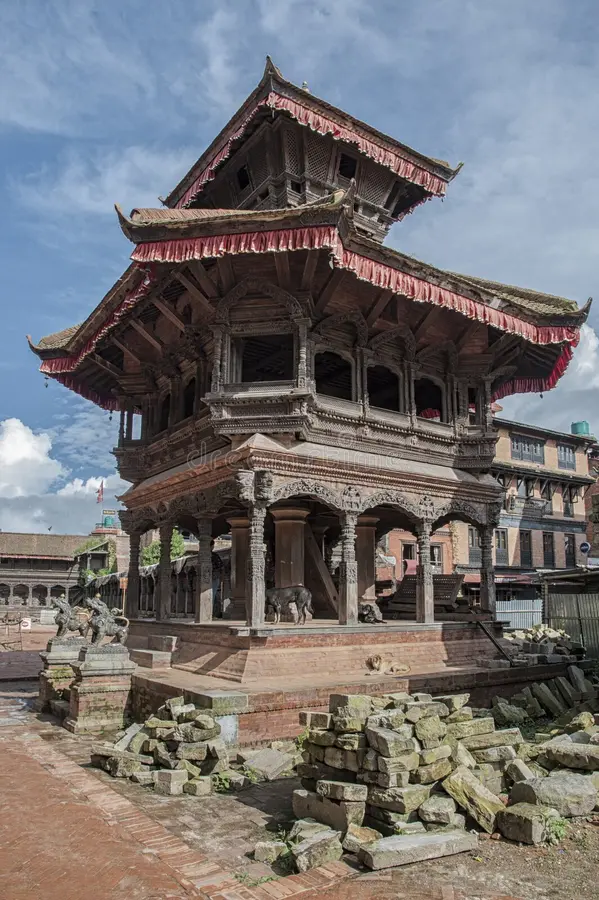
Nearby, the Vishwanath Temple with its two stone elephants guarding the entrance, the Bhimsen Temple painted in red and white, and the Taleju Bell — cast in 1736 — all tell stories of kings, gods, and craftsmen who poured their lives into building something eternal.
The Royal Palace and Its Hidden Courtyards
Behind the main square lies the Royal Palace, and within it, three magnificent courtyards — Mul Chowk, Sundari Chowk, and Keshav Narayan Chowk — each more breathtaking than the last.
Sundari Chowk is perhaps the most spectacular. A sunken royal bath sits at its center, surrounded by 72 niches carved into the walls — each one holding a statue of a different Hindu deity. The craftsmanship is so precise, so delicate, that it is difficult to believe human hands made it without modern tools. Mul Chowk, the oldest of the three, is guarded by two stone lions and features a gilded doorway flanked by statues of the river goddesses Ganga and Jamuna.
If you visit and have time for only one thing beyond the main square — walk through these courtyards. They are the soul of Patan.
Patan Museum: Where History Comes Alive
Just inside the palace entrance is the Patan Museum, widely regarded as one of the finest museums in South Asia. Its collection spans over 1,300 years of Newari art — bronze sculptures, stone carvings, ritual objects, and religious paintings displayed in beautifully restored rooms of the old palace itself.
For Nepali visitors especially, this museum is a revelation. The objects here are not distant artifacts — they are part of our own living religious and cultural traditions. You will recognize the gods, the rituals, the symbols. But you will see them here in a depth and context that transforms familiar things into something newly wondrous.
Admission is affordable, and the audio guide (available in Nepali) is highly recommended.
Beyond the Square: The Living Heritage of Patan
What makes Patan truly special is that its heritage does not end at the square’s boundary. The entire old city is a living museum.
Wander through the narrow lanes and you will discover bahals — traditional Buddhist monasteries built around open courtyards — tucked quietly between shops and homes. The Golden Temple (Hiranya Varna Mahavihar), a short walk from the square, is one of the most sacred Buddhist sites in Nepal, its facade gleaming with gilded copper and intricate metalwork.
The Ashokan Stupas — four ancient mounds said to have been built by Emperor Ashoka himself in the 3rd century BC — mark the four corners of the old city. Walking between them is a way of tracing the ancient city limits, feeling the shape of what Patan once was.
And everywhere — in doorways, on window frames, above temple entrances — you will see the extraordinary wood carving that Patan’s craftsmen are famous for. Peacocks, erotic carvings meant to ward off lightning, serpents, lotus flowers — each telling stories that have been passed down through generations of Newar artisans.
The Best Time to Visit
Patan Durbar Square is worth visiting any time of year, but a few moments make it truly unforgettable:
- Krishna Janmashtami (August) — The square transforms into a sea of oil lamps and devotees singing bhajans through the night, celebrating Lord Krishna’s birth at his own temple.
- Rato Machhindranath Jatra (April–June) — The great chariot festival begins in Lalitpur and draws thousands. The atmosphere is electric.
- Early morning, any day — Arrive before 8 AM when the light is golden, the square is quiet, and local vendors are setting up. This is Patan at its most peaceful and most real.
Getting There
Patan Durbar Square is just 20–30 minutes from central Kathmandu by road. You can take a local bus from Ratnapark or Lagankhel, hire a taxi, or even walk across the Bagmati River via the Pulchowk route. The LMC’s electric carriage service also offers a scenic ride through the heritage streets of Lalitpur — a memorable experience in itself.
Entry fee: Applicable for non-residents. Nepali citizens and SAARC nationals receive discounted or free entry — carry your citizenship card.
A Final Thought
We Nepalis are fortunate. We live in a country where ancient kingdoms, living traditions, and UNESCO World Heritage Sites are not museum-pieces behind glass — they are part of our daily landscape. Patan Durbar Square is not a relic of a lost civilization. It is a living place, where priests perform rituals at dawn, where children play in the same courtyards where Malla kings once held court, where craftsmen still practice arts their great-grandparents taught them.
It deserves more than a quick glance on the way somewhere else. It deserves a full day, a slow walk, and your genuine curiosity.
Come to Lalitpur. The City of Beauty is waiting.
For more information about visiting Lalitpur’s heritage sites, festivals, and community tourism experiences, visit tourism.lmc.gov.np
— LMC Tourism, Lalitpur Metropolitan City